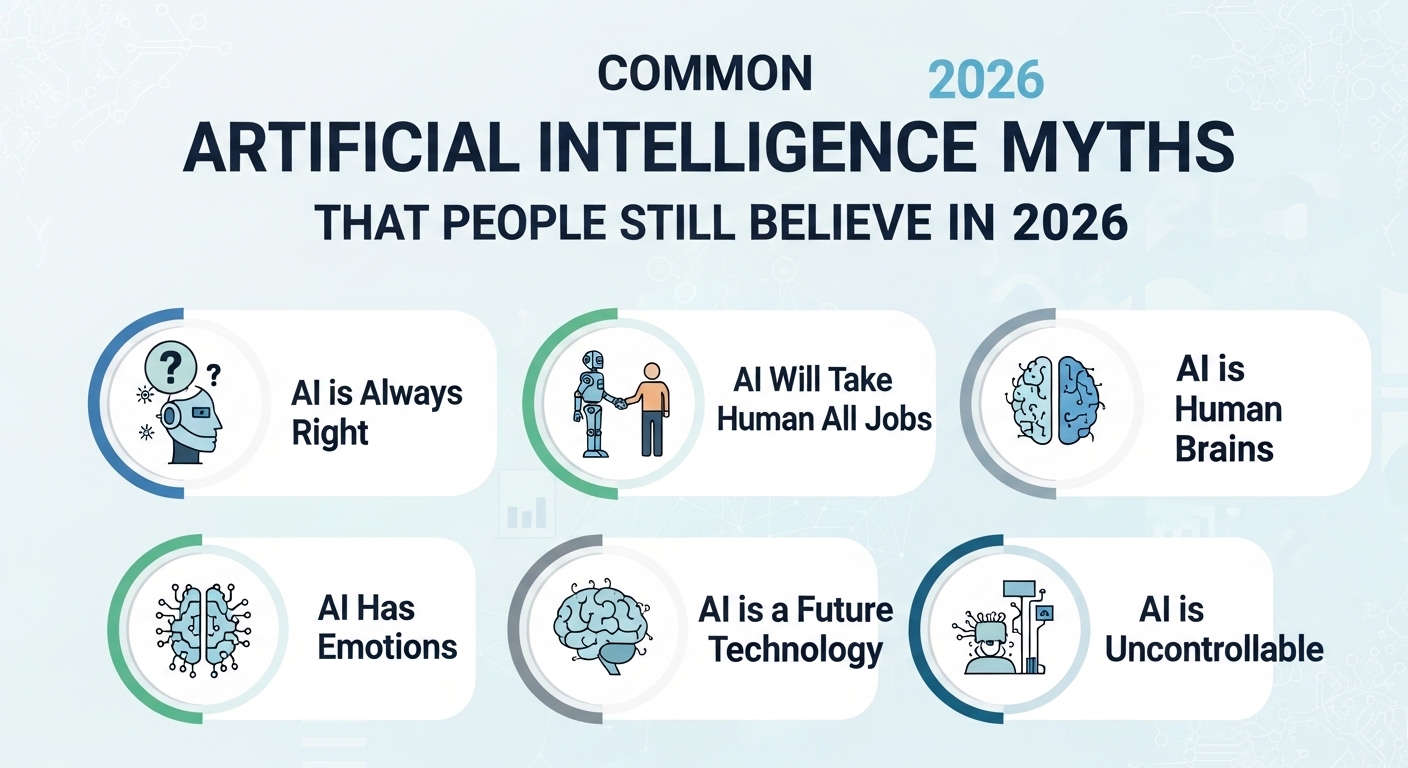
Artificial Intelligence has become one of the most talked-about technologies in the modern world. From smart assistants and automated customer service to advanced medical tools and self-driving systems, AI is now part of everyday life. Despite its rapid growth, many people still misunderstand what artificial intelligence can and cannot do. In 2026, several outdated beliefs continue to shape how people view this technology.
Understanding the truth behind these myths is important because misinformation can create unnecessary fear, unrealistic expectations, and confusion about the future of AI. Here are some of the most common artificial intelligence myths that people still believe in 2026.
Myth 1: Artificial Intelligence Can Think Like Humans
One of the biggest misconceptions is that AI thinks exactly like a human brain. Many people assume AI systems have emotions, consciousness, and personal opinions. In reality, AI works by analyzing large amounts of data and identifying patterns.
AI can generate text, recognize images, and predict outcomes, but it does not truly understand the world the way humans do. It processes information using algorithms rather than awareness.
The Reality
Artificial intelligence can simulate human conversation and decision-making, but it does not possess:
- Self-awareness
- Emotions
- Personal beliefs
- Independent consciousness
AI remains a tool created by humans, not a replacement for human thought.
Myth 2: AI Will Replace Every Human Job
Many workers worry that AI will eliminate all jobs in the near future. While automation is changing industries, the idea that every profession will disappear is exaggerated.
AI is better at handling repetitive tasks, data analysis, and routine workflows. However, many careers still require human creativity, empathy, and complex decision-making that machines cannot replicate.
Jobs Most Likely to Stay Human
Some roles continue to rely heavily on people, including:
- Teachers
- Therapists
- Creative professionals
- Business leaders
- Healthcare providers
Instead of replacing all jobs, AI is more likely to transform how people work.
Myth 3: AI Is Always Accurate
Because AI can process massive datasets quickly, many assume it always gives correct answers. This is not true. AI can make mistakes, generate false information, and reflect biases found in training data.
Even advanced AI systems can misunderstand context or produce misleading results.
Why AI Makes Errors
AI mistakes can happen because of:
- Poor training data
- Bias in datasets
- Limited context
- Outdated information
- Incorrect user prompts
This is why human review remains essential in many AI-powered systems.
Myth 4: AI Is Dangerous by Default
Movies and science fiction often portray AI as a dangerous force that could take over the world. While AI can be misused, the technology itself is not automatically harmful.
The real concern is how humans design and use artificial intelligence.
The Real Risk
Potential problems usually come from:
- Unsafe programming
- Lack of regulation
- Misuse by bad actors
- Privacy violations
- Unethical deployment
AI becomes dangerous when people use it irresponsibly, not simply because it exists.
Myth 5: AI Understands Everything You Say
Modern AI chatbots sound impressively natural, leading many people to believe they fully understand language. However, AI predicts responses based on patterns rather than genuine comprehension.
It can sometimes sound confident even when giving incorrect information.
Important Limitation
AI can:
- Recognize language patterns
- Summarize text
- Answer questions
- Translate languages
But it may still misunderstand sarcasm, humor, emotional nuance, or vague requests.
Myth 6: Artificial Intelligence Is Only for Big Tech Companies
Some people believe AI is only useful for major technology corporations. In 2026, AI tools are now accessible to individuals, startups, educators, and small businesses.
Today, many affordable AI tools help with:
- Writing content
- Customer support
- Image generation
- Data analysis
- Marketing automation
Small businesses can now use AI to compete more effectively without huge budgets.
Myth 7: AI Learns Completely on Its Own
Another common myth is that AI can teach itself everything without human involvement. While some systems improve through machine learning, humans still play a critical role.
People are needed to:
- Build algorithms
- Provide training data
- Set safety rules
- Monitor outputs
- Correct errors
AI may improve over time, but it still depends heavily on human guidance.
Myth 8: AI Has No Bias
Some believe AI is neutral because it is based on technology. In reality, AI can inherit bias from the data it learns from.
If the training data contains unfair patterns, the AI can repeat those same problems.
Examples of AI Bias
Bias may appear in:
- Hiring software
- Facial recognition
- Loan approvals
- Medical diagnosis
- Search results
Developers now focus more on creating fairer AI systems, but the issue still exists.
Why These AI Myths Continue in 2026
Misinformation spreads quickly online, and entertainment often portrays AI in unrealistic ways. Many people also interact with AI tools without understanding how they work.
Reasons these myths remain popular include:
- Social media exaggeration
- Science fiction influence
- Lack of technical knowledge
- Fear of change
- Sensational news headlines
Better education can help people understand the true capabilities of artificial intelligence.
Final Thoughts
Artificial intelligence is transforming the world, but many misconceptions still surround the technology in 2026. Believing outdated AI myths can create fear or unrealistic expectations that do not match reality.
The truth is that AI is a powerful tool, but it is not magical, perfect, or fully independent. As AI continues to evolve, understanding what it can and cannot do will become even more important for businesses, workers, and everyday users.
By separating fact from fiction, people can make smarter decisions about how to use AI responsibly in the years ahead.